When parents are not married in New Jersey, tax season often brings a wave of confusion and potential conflict. You might wonder if paying child support automatically grants you the right to the claim, or if a verbal agreement with your co-parent is enough to satisfy the IRS. At Barli Law LLC, we frequently guide clients through these exact questions.
Understanding the intersection of federal tax law and New Jersey family court orders is essential to protecting your finances and avoiding an IRS audit. If you are navigating a separation or need to formalize a family law agreement, the way you handle tax exemptions can have a lasting impact on your household’s financial health.
The Basic IRS Rule for Unmarried Parents
Federal tax law is clear on one point: only one parent can claim a child as a qualifying dependent in any single tax year. The IRS does not allow parents to “split” a single child on a tax return, though parents with multiple children can certainly agree to each claim one.
Generally, the IRS awards the dependency exemption and related tax benefits to the “custodial parent.” However, in the eyes of the IRS, “custody” is not determined by who has legal decision-making power. Instead, it is determined by where the child physically slept for the majority of the year.
Identifying the Custodial Parent
The IRS defines the custodial parent as the one with whom the child lived for more than half of the year specifically, 183 nights or more. It is a common misconception that earning a higher income or paying more in child support gives you the right to the claim. In reality, the IRS focuses on physical residency.
What Tax Benefits Are at Stake?
Claiming a child is about more than just a deduction. For many New Jersey families, it unlocks significant credits that can change a tax liability into a substantial refund.
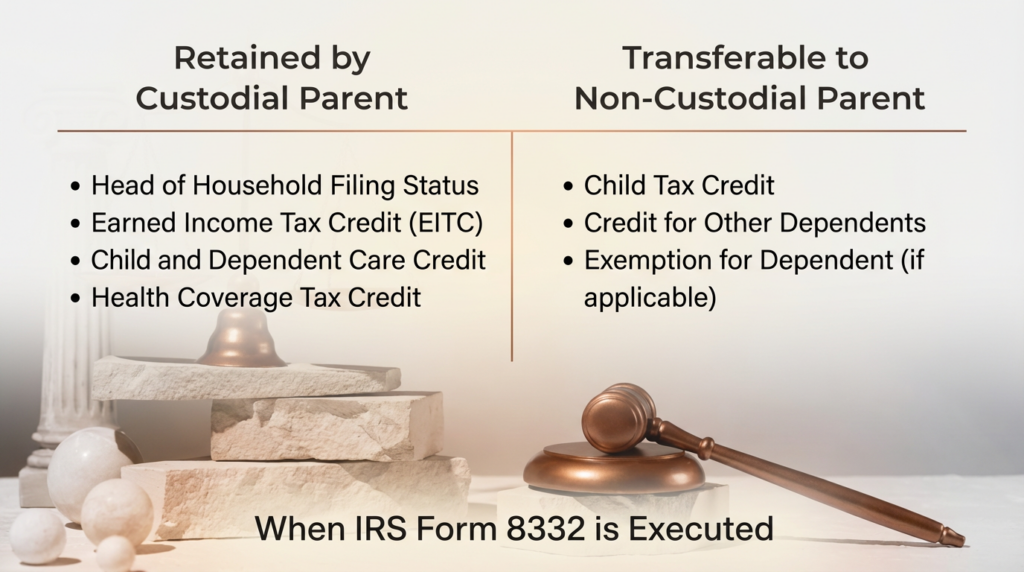
- Child Tax Credit (CTC): For the 2026 tax year, the maximum credit is $2,200 per child under age 17.
- Earned Income Tax Credit (EITC): This is a refundable credit for low-to-moderate-income working parents.
- Head of Household Filing Status: This status offers a higher standard deduction and lower tax rates than filing as “Single.”
- Child and Dependent Care Credit: This helps offset the costs of daycare or after-school programs.
Can the Non-Custodial Parent Ever Claim the Child?
Yes, but the process must be handled with precision. The custodial parent can “release” their claim to the dependency exemption, allowing the non-custodial parent to claim the child. This is common in cases where the non-custodial parent has a higher tax liability and the credit provides a greater overall benefit to the family’s total resources.
The Power of IRS Form 8332
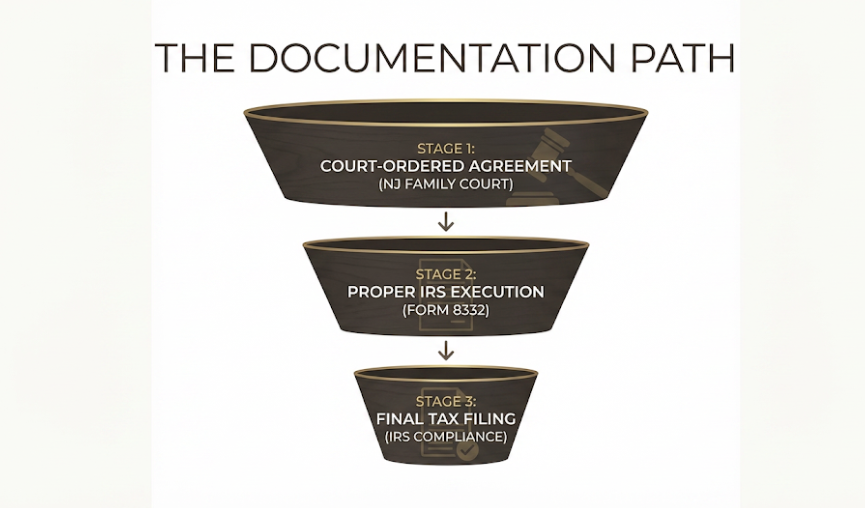
To legally transfer the claim, the custodial parent must sign IRS Form 8332. This form is the only document the IRS recognizes for this transfer. Even if you have a signed contract dispute settlement or a court order stating you can claim the child, the IRS may still reject your claim if Form 8332 is not attached to your return.
What If There Is a New Jersey Custody Order?
New Jersey courts often include tax-claiming provisions in child custody orders. For example, a judge might order that parents alternate years or that the parent paying child support gets the claim every year.
While these orders are legally binding in New Jersey, they do not automatically override federal IRS software. If your court order says you can claim the child but the other parent refuses to sign Form 8332, you cannot simply “take” the claim. Doing so will likely trigger an audit. In these cases, you must return to family court to enforce the order. Our team at Barli Law LLC assists parents in enforcing these provisions so they receive the financial benefits they were promised.
What Happens if Both Parents Claim the Child?
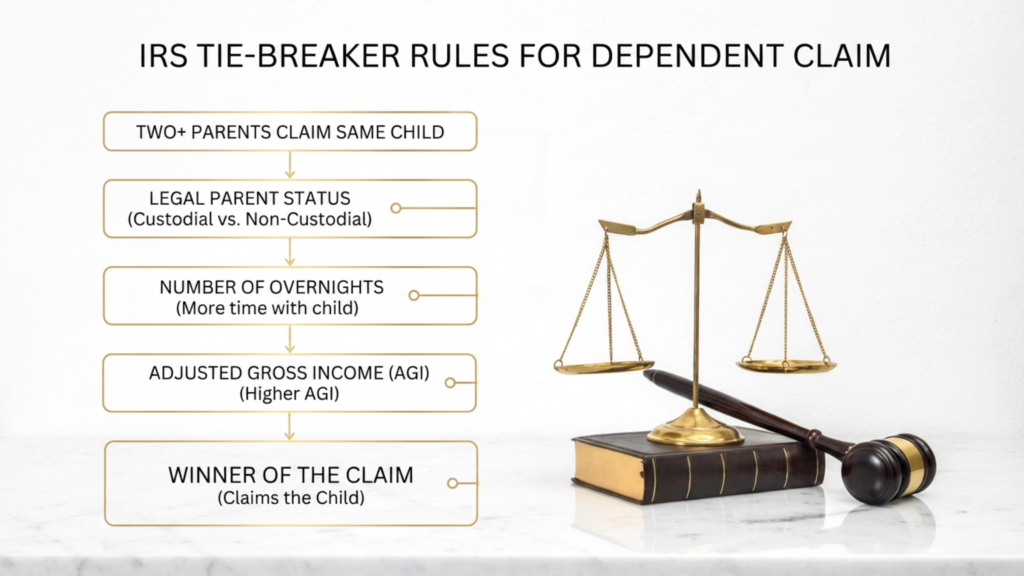
When two parents file separate returns claiming the same Social Security number for a child, the IRS “Tie-Breaker” rules kick in. This usually begins with the IRS rejecting the second return filed electronically.
The IRS Tie-Breaker Rules
If both parents insist on claiming the child and cannot reach an agreement, the IRS applies a specific hierarchy to determine the winner:
- Residency: The parent the child lived with the longest wins.
- Adjusted Gross Income (AGI): If the child lived with both parents for an equal amount of time (which is rare in 365-day years), the parent with the higher AGI wins.
Filing a duplicate claim can lead to delayed refunds, interest charges, and penalties. It is always better to resolve these issues through a formal divorce or custody agreement before tax season arrives.
Special Situations in New Jersey
50/50 Custody Arrangements
In a true shared-parenting time arrangement, parents often believe they have equal rights. However, since a year has 365 days, one parent usually has at least one more overnight (183 vs. 182). That one night makes them the custodial parent for tax purposes.
Unmarried Parents Living Together
If you are unmarried but living in the same household with your child, only one of you can claim the child. You cannot both file as Head of Household using the same child. Deciding which parent claims the child should be based on who receives the most significant tax advantage, which can then be shared within the household.
Multiple Children
If you have more than one child, the most common solution is to divide the claims. One parent claims one child, and the other claims the second. This avoids the need for Form 8332 and simplifies the filing process for both parties.
Why This Matters in Family Law Cases
Tax claims are often used as a tool in broader negotiations regarding child custody and support. A parent might agree to lower child support payments in exchange for the tax claim, or vice versa. When structured correctly, these arrangements promote fairness and ensure both parents are contributing to the child’s upbringing in a way that makes financial sense.
Frequently Asked Questions
1. Does paying child support give me the right to claim my child?
No. Under IRS rules, child support payments do not determine who claims the child. The right stays with the parent who has the child for the majority of overnights unless a Form 8332 is signed.
2. Can parents alternate claiming the child each year?
Yes. This is a very common arrangement in New Jersey family law. However, the custodial parent must still provide the non-custodial parent with a signed Form 8332 during the years the non-custodial parent is taking the claim.
3. What if the other parent claimed my child without permission?
If you are the rightful custodial parent and the other parent claimed the child, you will likely need to file a paper tax return. The IRS will then investigate both claims. It is highly recommended to contact a family law attorney to discuss enforcing your rights.
4. Does a New Jersey custody order override IRS rules?
No. Federal law always controls tax filings. However, a New Jersey court can hold a parent in contempt if they refuse to follow a court order regarding tax claims, such as refusing to sign a required IRS form.
5. Can I claim Head of Household if I am not married?
Yes, provided you are the custodial parent, you paid more than half the cost of keeping up a home for the year, and the child lived with you for more than half the year.
Protect Your Rights and Avoid Costly Tax Disputes
Tax season shouldn’t be a source of legal dread. By establishing clear, written agreements during your custody or divorce proceedings, you can avoid the stress of IRS audits and family court disputes.
If you are navigating custody, support, or financial disagreements after a separation in New Jersey, Barli Law LLC is here to help. We provide the precise, solution-focused advocacy you need to protect your financial interests and your family’s future.
If you have questions about your specific case, reach out to the team at Barli Law LLC today to schedule a consultation. You can also call us directly at (973) 638-1101.