
If you are currently paying or receiving child support in New Jersey, you are likely navigating one of the most stressful financial transitions of your life. During a divorce or separation, every dollar counts, and understanding how the government views these payments is essential for accurate budgeting.
A common point of confusion for parents is whether child support affects their “bottom line” during tax season. Does the parent receiving support have to report it as income? Can the parent paying support deduct it to lower their tax bracket? At Barli Law LLC, we help New Jersey families demystify these rules so they can focus on what truly matters: the well-being of their children.
Is Child Support Considered Taxable Income?
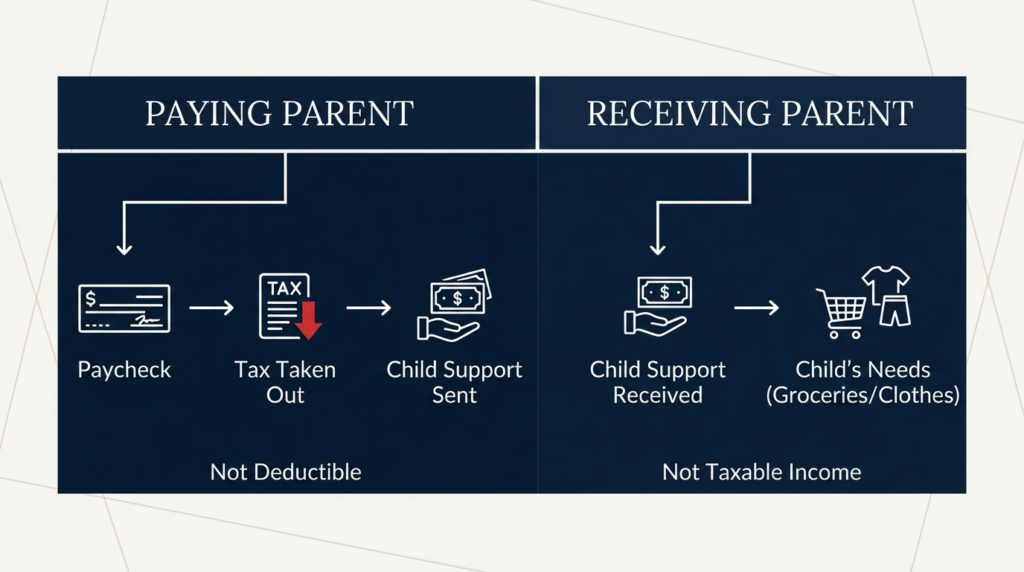
The short answer is no. Under federal tax law, which remains consistent through 2026, child support is not considered taxable income to the parent who receives it.When you receive child support in New Jersey, the IRS views these funds as a “neutral” transfer of money for the care of a minor. Because the money is meant to provide for the child’s basic needs such as housing, food, and clothing it is not treated as a financial “gain” for the parent.

Key Rules for Recipients:
- No Reporting Required: You do not need to list child support payments as “Gross Income” on your federal or New Jersey state tax returns.
- Tax-Free Usage: You do not pay income tax on these funds. Whether you receive $500 or $5,000 a month, it does not increase your tax liability.
- Consistency: This rule applies regardless of whether the support is paid through a municipal court order, a private agreement, or a probation department.
Is Child Support Tax Deductible for the Paying Parent?
Conversely, child support is not tax deductible for the parent who makes the payments. If you are the “obligor” (the parent paying support), you must pay those funds using “after-tax” dollars.
What This Means for Payers:
- No Deduction: You cannot subtract child support payments from your taxable income to lower your tax bill.
- Full Taxation: You are essentially taxed on the money you earn before you send the child support portion to the other parent.
No Adjustments: Even if your support payments are substantial, they do not lower your adjusted gross income (AGI), which is the number the IRS uses to determine your eligibility for other credits.
Why Child Support Is Treated Differently from Alimony
It is easy to confuse child support with alimony (spousal support), but the legal and tax distinctions are critical.
Child Support is focused entirely on the child’s well-being. It is calculated using the New Jersey Child Support Guidelines, which take into account both parents’ incomes and the amount of time the child spends in each household. It is never deductible and never taxable.
Alimony, however, has a “split” history in tax law. For any family law agreement finalized before January 1, 2019, alimony was generally deductible for the payer and taxable for the recipient. For agreements finalized after that date (including all new 2026 orders), alimony follows the same rule as child support: it is neither deductible nor taxable at the federal level.
Does New Jersey Tax Child Support?
New Jersey state tax laws generally mirror federal treatment. This means that at the state level:
- Child support is not taxable income.
- Child support is not deductible.
Maintaining consistency between state and federal filings helps prevent errors, but it also means that New Jersey parents cannot look to state-specific “loopholes” to change the tax status of their support payments.
What About Arrears or Lump Sum Payments?
In some cases, a parent may fall behind on payments, leading to “arrears.” If you eventually receive a large lump-sum payment for past-due support, you might worry that a sudden influx of cash will trigger a tax event.
Fortunately, the tax treatment does not change. Whether the support is paid monthly or in a single large payment to settle a debt, it is still categorized as child support and remains non-taxable. However, unpaid support can lead to significant legal consequences, such as the interception of federal tax refunds. If you are struggling with unpaid support, Barli Law LLC can assist you in enforcing court orders to ensure your child receives what they are owed.
Does Claiming the Child Affect Tax Treatment?
While child support itself is a tax-neutral event, the right to claim the child as a dependent is a separate, highly valuable issue.
The parent who claims the child may qualify for:
- The Child Tax Credit: A direct credit against taxes owed.
- Head of Household Status: A more favorable filing status than “Single.”
- Earned Income Credit: A refundable credit for low-to-moderate-income earners.
It is a common misconception that paying child support gives you a “right” to the claim. As we discuss in our guide on 50/50 custody tax claims, the IRS residency rules (who the child lived with for 183+ nights) generally decide who gets the claim unless a specific agreement is in place.
Significant 2026 Changes to New Jersey Custody Laws

As of January 2026, New Jersey implemented “Kayden’s Law,” which dramatically shifted how child custody is handled in contested cases. The law now prioritizes child safety as a “threshold inquiry” before considering the traditional “best interests of the child” standard.While these changes are focused on safety, they directly impact child support calculations. Because child support in New Jersey is heavily tied to “overnights,” any change in the custody schedule resulting from these new safety standards will lead to a change in the support amount. If your parenting time has been modified under these 2026 updates, you should contact Barli Law LLC to discuss a child support modification.
How Child Support Is Calculated in New Jersey
To understand why child support is tax-neutral, it helps to look at how the number is reached. New Jersey uses the “Income Shares Model,” which assumes that the child should receive the same proportion of parental income as they would have if the parents lived together.
The formula considers:
- Combined Net Income: After certain mandatory deductions (like taxes) are taken out.
- Number of Children: The “basic support obligation” increases with more children.
- Specific Expenses: Such as health insurance and work-related childcare.
- The Parenting Time Schedule: A parent with more overnights may receive a “parenting time adjustment” to account for the costs of maintaining a home for the child.
Common Misunderstandings About Child Support and Taxes
- Misconception: “I can deduct it as a business expense.” Legal fees and child support payments are considered personal expenses and are never deductible as business costs.
- Misconception: “If I pay for 100% of the child’s needs, I get the tax claim.” Even if you pay more support than the other parent, the IRS still prioritizes the “custodial parent” (residency) for the claim.
- Misconception: “The IRS will tell me how much to pay.” The IRS has nothing to do with setting child support amounts; that is strictly a function of the New Jersey Superior Court.
Frequently Asked Questions
1. Is child support taxable in New Jersey?
No. Neither the federal government nor the State of New Jersey taxes child support payments.
2. Can I deduct child support payments on my taxes?
No. There is no tax deduction available for child support payments.
3. Does child support affect my ability to claim Head of Household?
Not directly. To file as Head of Household, you must meet residency and “cost of home” requirements. Receiving child support can help you pay for those home costs, but the support itself is not what qualifies you.
4. Is alimony taxed the same way as child support?
For all orders signed after January 1, 2019, yes alimony is also non-taxable and non-deductible.
5. If I stop receiving child support, can that affect my taxes?
The loss of support won’t change your tax treatment, but it may lower your overall household resources, which might affect your eligibility for certain low-income tax credits.
Protect Your Financial Interests in Support Matters
Child support is designed to ensure that children of separated parents have the resources they need to thrive. However, when financial obligations are misunderstood, it can lead to resentment, missed credits, or IRS penalties.
At Barli Law LLC, we take a solution-focused approach to family law. We assist parents with establishing support, seeking modifications when incomes change, and guardianships or other complex financial arrangements.
Legal challenges can be overwhelming, but you don’t have to navigate them alone. If you have questions about your specific case, reach out to the team at Barli Law LLC today to schedule a consultation. You can also call us directly at (973) 638-1101.